The Problem With Doing Everything Right in College Admissions
Why high-achieving Muslim families often optimize the application and neglect the applicant
The Problem With Doing Everything Right in College Admissions
A few months ago, a family reached out to us at Five Before College. They had done their homework. And I mean done it.
They had built an entire college strategy using ChatGPT. They had pulled data from common data sets, cross-referenced acceptance rates, mapped out reaches and safeties, and assembled a spreadsheet that most counselors would approve of.
The parents were sharp, educated, and clearly devoted to their child's future.
I was genuinely impressed.
We sat together on Zoom, and they walked me through all of it. Course selection. Testing. Activities. Admissions probabilities. They had answers to many questions before I even asked.
But then I asked if I could speak to their child directly.
The energy shifted immediately.
I asked the student a bit of an unusual question:
"Imagine you have children of your own someday. What's something you're feeling right now that you would not want your future children to feel?"
And everything spilled out.
Not knowing who I am. Not feeling like I have any real passions or purpose. Just going along for the ride. Being busy all the time but not knowing what any of it means.
Here was a student with a flawless plan but nothing at the center.
The family had developed a technically solid admissions strategy.
But the person at the center of it felt like a passenger just coming along for the ride.
Two Kinds of Problems
There's a distinction I think about constantly, and I believe it's the single most important thing Muslim families misunderstand about college admissions.
Some problems are complicated.
A car engine is complicated. The FAFSA is complicated. Coding an app is complicated. These things have a lot of moving parts, but they're ultimately knowable. You can gather the right information, consult the right experts, follow a sound process and reach a reasonably reliable answer.
Other problems are complex.
Raising a teenager is complex. Building a marriage is complex. Forming your identity as a practicing Muslim in today's America is complex. The parts interact in unpredictable ways. There is no formula. More data doesn't necessarily help. And more control often makes it worse.
College admissions sits right at the intersection of the two.
The applications, financial aid forms, standardized testing, school list, course strategy, and activity descriptions are complicated. They matter. Families should approach them seriously. We certainly do, and we provide a lot of guidance in those areas.
But underneath them sit a different set of questions:
Who is my child becoming? Do they know what they care about? Have they learned to make meaningful decisions? Can they explain what they believe and why? Are they becoming a whole person, or merely assembling a collection of résumé lines?
Those are complex questions.
And many high-achieving families are pouring nearly all their energy into the complicated problem of college admissions while the complex challenge of raising the person who will attend college is overlooked, neglected, and ultimately never given the energy and attention it needs.
The Blueprint Trap
I see this most often in parents who have built successful lives by becoming excellent complicated-problem solvers.
Doctors. Engineers. Executives.
These parents know how to gather information, manage risk, anticipate obstacles, and create a plan. Their skills, discipline, instincts, and training have served them extraordinarily well.
Then their child reaches eighth or ninth grade, and the parents bring the same approach to college admissions.
They create the blueprint.
The right courses. The right summer programs. The right extracurricular activities. The right volunteer work. The right sequence of accomplishments.
One family I worked with had mapped out their daughter's path beginning in eighth grade. She would attend an Ivy League university. Full stop.
There was a medical research program abroad. Volunteer work with NGOs. The Girl Scout Gold Award. Each decision made perfect strategic sense.
Their daughter cooperated.
But with every important decision made for her rather than by her, something quietly accumulated: resentment.
Eventually, she told her parents: "I love you, but I don't like you."
That sentence should make every parent stop to think.
The danger is not that parental planning never works. It often works, at least in the narrow sense. The child may earn the grades, complete the programs, win the awards, and construct the résumé. They may even get into their dream college.
The danger is that the process can produce compliance without agency.
A student can arrive at the finish line with an impressive application but no real understanding of why they ran the race.
There is an especially painful version of this dynamic in immigrant families.
Many Muslim parents came to this country with very little. Five dollars and a dream. They built incredible lives through sheer grit, sacrifice, and the fire of necessity. They achieved the American dream, the nice suburb, the good school district, the comfortable life.
Then they look at their children and wonder:
Where is the hunger? Where is the drive? When I was your age, I would have done anything for these opportunities. You have everything, and you cannot get off your phone.
But sometimes the fire is missing because, in protecting our children from the hardships we endured, we also remove the friction through which agency is built.
The answer is not to manufacture suffering or romanticize deprivation.
It is to stop rescuing teenagers from every worthwhile struggle.
They need to make decisions with real consequences. They need to attempt things that might fail. They need responsibilities that actually matter. They need to discover that their own actions can move something real in the world.
Agency cannot be taught in a lecture.
It must be gained through experience.
Authenticity Cannot Be Manufactured
This matters for who the child becomes. It also matters for the college application.
A flawless application can still feel strangely empty. Not because it lacks focus. A student who loves medicine can reasonably pursue research, shadowing, and a summer clinical program. The problem is not focus. The problem is interchangeability.
When every line looks borrowed from the same admissions playbook, the reader cannot find the person underneath it.
I think about a junior I interviewed not long ago. On paper she was the model pre-med applicant. Everything pointed in the same direction. Everything matched.
Then, near the end of our conversation, almost as an afterthought, she mentioned something else. During the pandemic she had started a small account where she posted her own realistic drawings. Pencil portraits, mostly. She had stopped posting a while back. She brought it up like it was a slightly embarrassing hobby, something that surely had no place next to Calculus BC and hospital volunteering.
But in a ninety minute conversation, that was the first time she sounded like herself.
Take a moment and sit with what that means. The truest thing about her was the thing she almost didn't mention. She had learned to treat it as a throwaway, a detail that couldn't possibly belong on a college application, when it was actually the only detail on the application that was unmistakably hers.
We call that the "red umbrella." The thing that makes you stand out in a field of near-identical profiles, not because you're better, but because you're different.
Here is the part that should worry every parent: it almost went unmentioned. Nobody had thought to ask. A few more months of everyone optimizing the same flawless plan, and it might have stayed buried under Calc BC for good.
You cannot manufacture that detail in the fall of senior year. But ask a young person the right questions early enough, and you do not have to. It is already there, waiting to be noticed, owned, and invested in.
Tie Your Camel
At this point, I'm sure some of you are thinking that I am telling you to step back, abandon strategy, and hope your teenager figures it out.
I am not.
Strategy and planning are essential. The Prophet ﷺ taught us to tie the camel and then place our trust in Allah.
We should tie it well.
At Five Before College, we build long-term academic road maps. We help families make intelligent course-selection decisions. We analyze college lists, testing strategy, activities, positioning, essays, and financial options. The complicated work is real, and it must be taken seriously and done with excellence.
But it cannot be the starting point.
Before we ask where a student should apply, we need to ask who is applying. Before we decide what will look impressive, we have to ask what the student might find meaningful. And before we help teenagers present themselves to an admissions committee, we have to help them understand themselves honestly.
That is why we begin with Find Your Qibla.
Find Your Qibla starts by helping students to become aware of the patterns already present in their lives.
What do you love? What do you lose track of time doing? What are you consistently praised for? What do your friends come to you for? Where do your abilities improve other people's lives? And what problem in the ummah are you unable to ignore?
We do not ask a fourteen-year-old to declare a lifelong purpose.
We help them notice what is already there, test directions through real experiences, and slowly take ownership of choices that parents, schools, and social expectations have too often made for them.
The point is not instant certainty.
The point is the shift from passenger to participant.
Becoming More Than One Thing
That first student, the one with the perfect spreadsheet? When we took her through Find Your Qibla, something unlocked.
They had been forcing themselves into a false binary: am I a STEM person or a humanities person? They felt this compulsion to choose. And they realized, through the work, that they didn't have to.
Their child loved journalism, telling the real stories of children and immigrants in their community, giving voice to the voiceless. But they were also genuinely obsessed with nuclear fusion. They couldn't stop reading about it. They believed the energy of the future is nuclear, and they wanted to be part of that story.
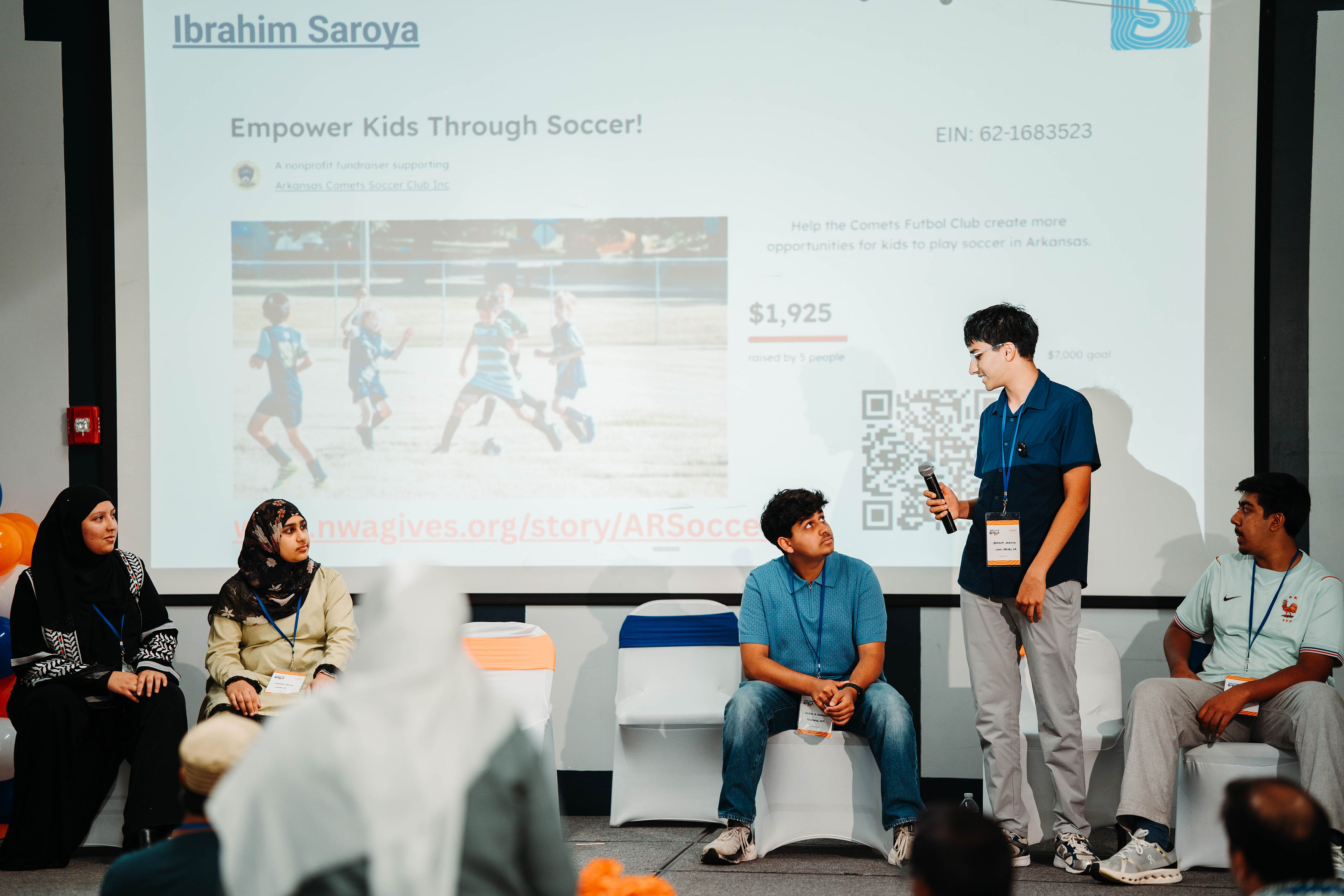
Find Your Qibla gave them permission to be both.
They got involved with a PBS documentary on one side and pursued high-level physics research on the other. Not because it produced a perfectly uniform profile, but because both grew out of two honest parts of the same person.
By the time applications opened, the student was no longer just trying to "look good for college." They were writing from something real.
Their essays were unusual, textured, and buzzing with life.
Alhamdulillah, they received acceptances from Ivy League universities, leading liberal arts colleges, and flagship public universities offering full funding.
But the deepest result was not the list of acceptances. The student recently told me that Find Your Qibla was the turning point, not because it helped them get into great schools, but because it helped them stop feeling like a passenger in their own life.
That is the outcome that matters.
What Breaks
I need to be direct about what's at stake here, because this isn't an intellectual distinction. This is what I've watched happen to real families.
When you treat this process as purely complicated, when you follow the perfect blueprint and neglect the real human complexity underneath, you can get burned-out high achievers who collapse their first semester of college. Unfortunately, kids who held it together through sheer willpower for four years of high school often simply cannot sustain it once the external structures of high school and home life are no longer there.
And this can lead to quiet erosion of deen. When faith was never integrated into this process, when Islam was treated as separate from or even a hindrance to the "real" work of getting in, students arrive on their college campus with no spiritual foundation to stand on when things get hard.
And the risk of a rift between parents and child is real. The relationship that matters most, strained to breaking by years of rigid adherence to a blueprint, can fracture right at the moment when your child needs you the most.
Too often, students reach the university they spent years chasing and quietly wonder: was this all there was?
I'm sad to say I've watched every single one of these things happen far too many times.
The Real Admissions Day
College admissions is often the first time many teenagers taste rejection.
No matter how carefully we plan, not every door opens. Selective admissions is unpredictable, and there are always more qualified students than seats at a top school.
That is where tawakkul stops being an abstract idea.
We tie the camel. We work with excellence. We make intelligent, strategic decisions. We submit the strongest application we can.
Then we surrender the outcome.
For the believer, an acceptance becomes an occasion for shukr. A rejection becomes an occasion for sabr. Neither result is spiritually wasted.
And that points toward the larger truth Muslim families cannot afford to forget.
The real admissions day is not Ivy Day.
It is Yawm al-Qiyamah.
If you receive your book of deeds in your right hand, you are completely successful. If Allah SWT says to you, "I am pleased with you, and never again will I be displeased with you," that is the greatest acceptance letter ever written. Nothing else comes close.
And here's the beautiful paradox.
Our Muslim kids, the kind of kids who come to Five Before College, already have a massive advantage that they don't even realize. Islam already gives them a framework for life that is inherently filled with meaning and purpose. The deen is already there. The fitra is already there.
The challenge is that so many families allow the competitive pressure of this process to suppress what they already know. They put the deen in one box and the college strategy in another, as if they were separate.
They're not.
When our children turn toward Allah, the dunya does not necessarily hand them every outcome they want. But it loses the power to tell them who they are.
That is what it means to Find Your Qibla.
It is not just a college strategy. It is a life strategy.
Because the best college outcome is not an acceptance letter.
It is a young person who knows who they are when they arrive.
P.S. This is the foundational work we do in the Find Your Qibla program. We help students build a real sense of purpose, take ownership of their own lives, and then build an admissions strategy around the person they are becoming. If you are interested and want to see if this is a good fit for you, please book a short 15-minute strategy call here.